Why is Calder a major figure in art?
- Post category:Artist Profiles
- Reading time:5 mins read
From wire portraits to suspended mobiles, Calder profoundly transformed modern sculpture.
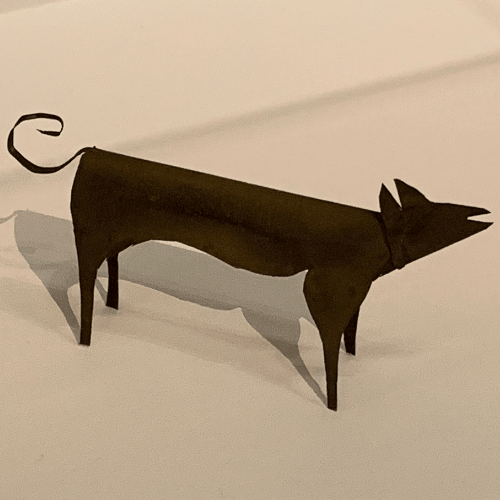
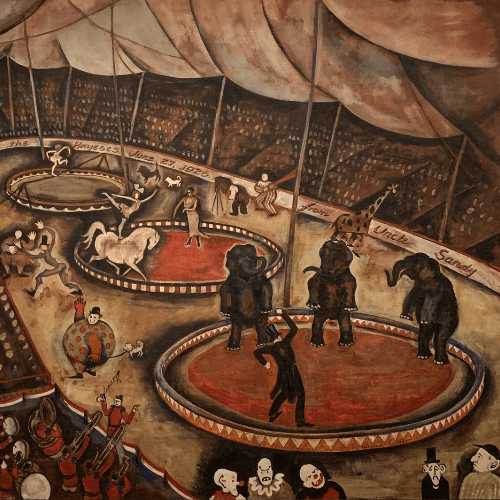
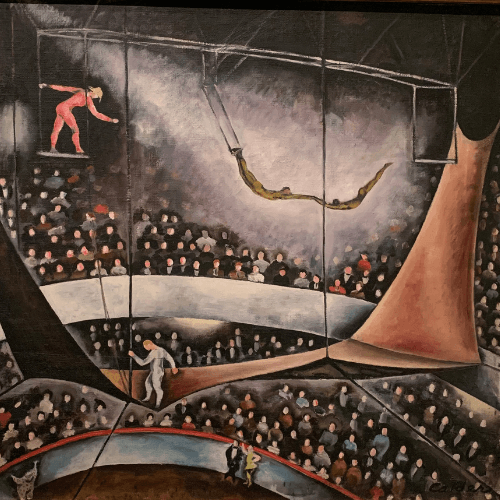
Born in Pennsylvania in 1898 and having died in New York in 1976, Calder came from a family of artists through his parents and grandparents. He earned a degree in mechanical engineering in 1919, but very quickly abandoned that path to devote himself to art. However, his technical training enabled him to create sculptures that no other artist had made before him. It was in Paris, where he settled in 1926, that he invented an entirely new visual language combining volume, staging, abstraction, performance, and mechanics with Calder’s Circus.
This miniature circus was not simply a sculpture; it was a portable work that the artist performed in front of audiences in Paris, Berlin, and New York. From this Parisian period onward, everything was already there: economy of means, a love of play, balance, and movement.
Why does his work still speak to us so powerfully today?
At a time when modernity was often expressed through cold abstraction, Calder joyfully set his works in motion. His sculpture does not illustrate life; it is life. And that is undoubtedly why his work remains immediately accessible to everyone.
The mobiles
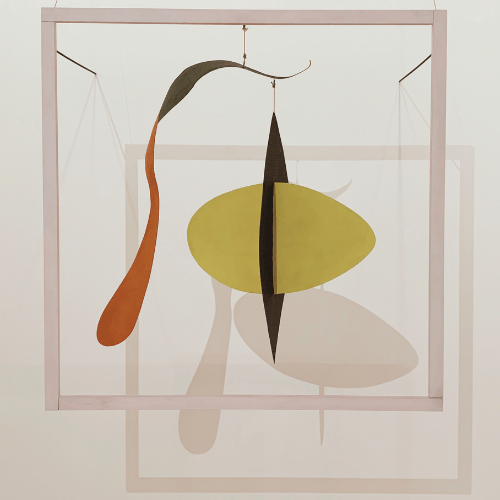
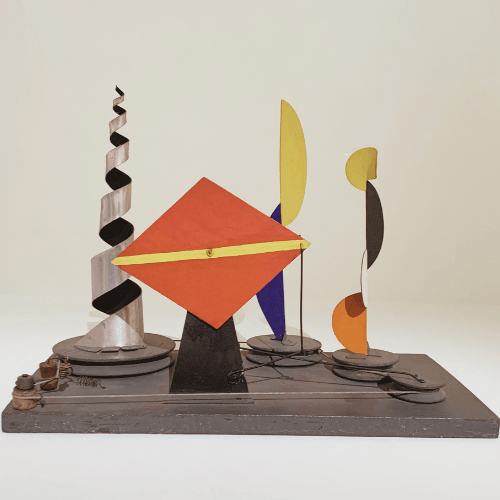
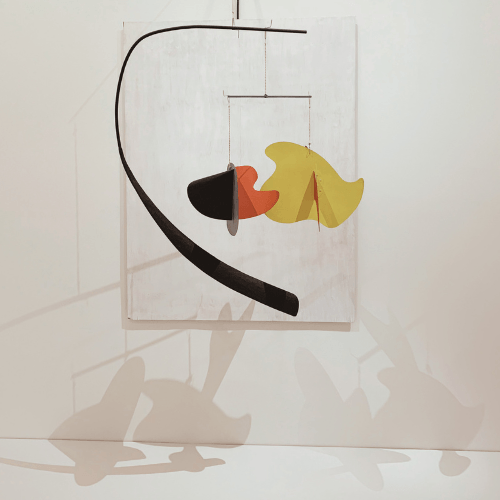
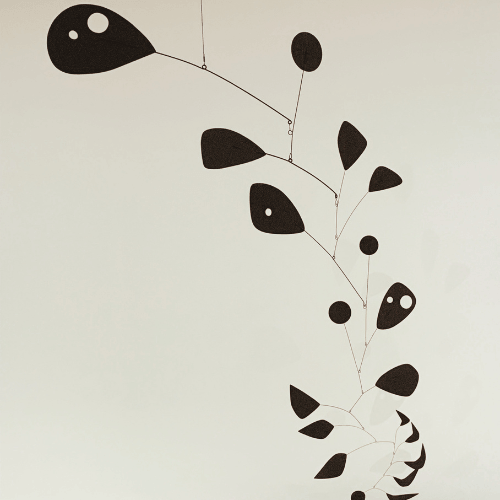
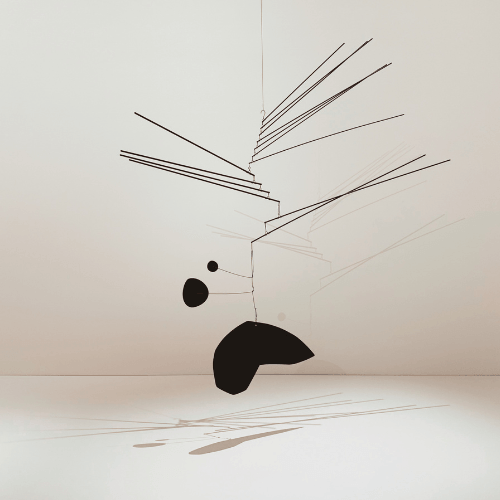
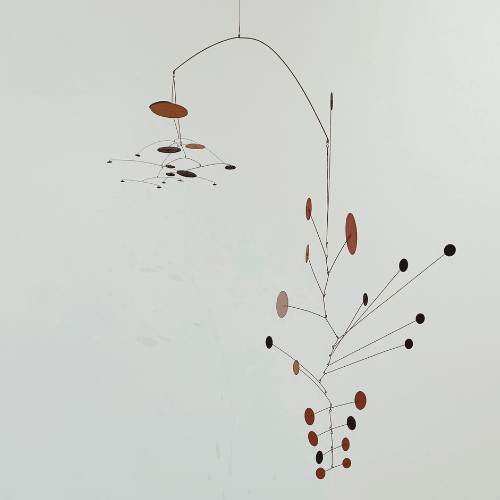
It was his air-sensitive sculptures that made Calder world-famous. From the early 1930s onward, he developed abstract sculptures in motion. His visit to Mondrian’s Paris studio in 1930 marked a turning point for Calder. He first painted minimalist abstract paintings, then developed kinetic works, “articulated machines,” which Marcel Duchamp, as an artist-thinker of art, suggested calling “mobiles.”
Once again, Calder’s training as a mechanical engineer enabled him to create works based on an extremely refined understanding of weight, force, and counterweight. The slightest current of air sets them in motion.
Stabiles and monumental sculptures
But Calder did not limit himself to light suspended works. Alongside the mobiles, he also developed fixed constructions, the stabiles, followed by large abstract sculptures in painted steel that occupy outdoor public spaces.
This is another major reason for his recognition: Calder covered the entire spectrum of sculpture, from wire works weighing only a few grams to monumental pieces weighing several tons. The first are studio works, while the latter are outdoor works, yet all are marked by elegance, movement, and joy.
1940–1970: recognition and legacy
In 1937 in Paris, the architect Josep Lluís Sert and the painter Joan Miró invited him to contribute to the decoration of the Spanish Pavilion for the International Exposition, where he exhibited alongside Picasso’s Guernica.
From the 1940s onward, Calder established himself as a major figure in modern sculpture. In 1952, he represented the United States at the Venice Biennale, where he won the Grand Prize for Sculpture. His recognition became fully international with major projects such as the monumental ensemble Spirale for UNESCO.
A complete artist, Alexander Calder also created “wearable sculptures,” meaning adornments and jewelry made of silver, gold, or brass, silver wire, or steel wire.
Sculptor of the wind
In 1946, the art critic Gabrielle Buffet captured the full poetry and originality of Calder’s work by describing him as a “sculptor of the wind” and a “lunar blacksmith.”
For the philosopher Jean-Paul Sartre, his mobiles “feed on air, they breathe, they borrow their life from the vague life of the atmosphere.” With the suspended mobile, the emblematic form of his work, Calder truly overturned the expectations of sculpture.
Where can you see Calder’s works?
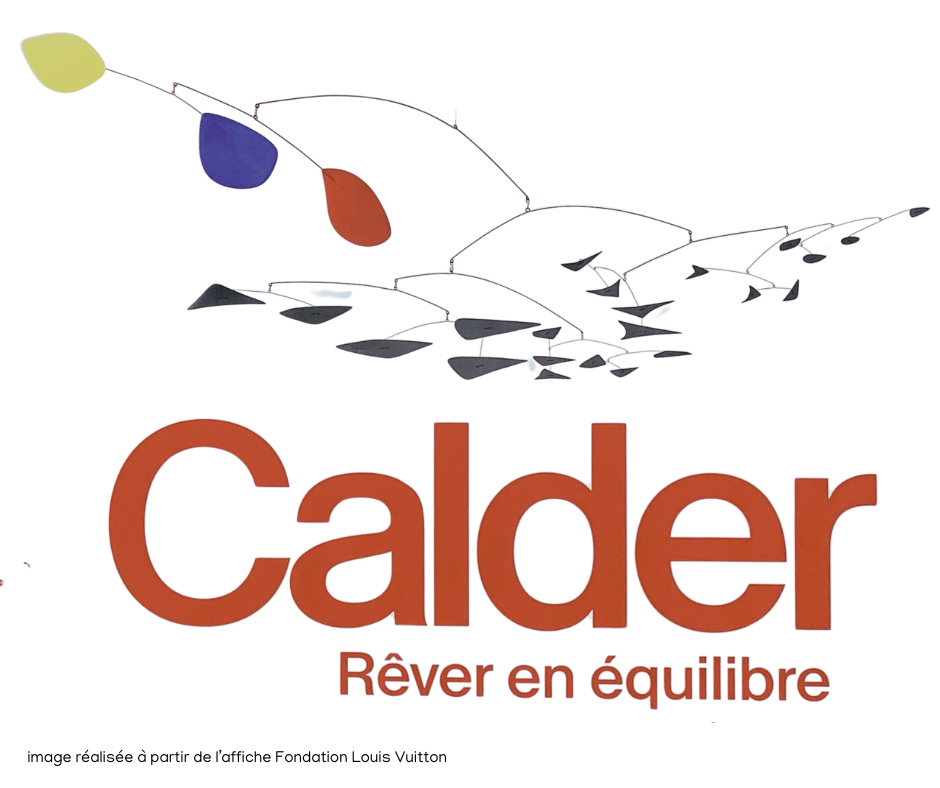
● The Fondation Louis Vuitton in Paris, which is presenting the exhibition Calder. Dreaming in Balance from April 15 to August 16, 2026, with more than 300 works covering his entire career.
● The Centre Pompidou / Musée National d’Art Moderne in Paris, which holds several major works by the artist.
● The National Gallery of Art in Washington, whose East Building has the largest permanent collection of Calder’s work in the world.
● MoMA in New York, which holds a very important group of his works.
Further reading – Recommended books
In French:
- Calder, the official exhibition catalogue, published by Hazan for the Fondation Louis Vuitton in 2026.
- Calder: les années parisiennes, 1926–1933, Éditions du Centre Pompidou, 2009, 420 pages.
In English:
- Calder: Modern from the Start, exhibition catalogue, MoMA, 2021.
In summary, Alexander Calder is famous for:
- Inventing sculptures in motion with his mobiles
- Inventing abstract sculpture in primary colors
- Creating monumental constructions known as “stabiles”
- Developing a joyful and simple universe between circus, performance, and poetic mechanics
- Bringing together play, rigor, balance, and inventiveness across every scale, from the lightest works to the most monumental ones.
© ArtistesActuels.fr – l’émotion des découvertes artistiques